Our Farm
Building Export-Grade Peanuts from the Ground Up
At Taha Land, farming is not a seasonal activity — it is a controlled production system built to deliver consistent, export-grade peanuts.
We believe that real quality starts long before harvest. It starts with the right land, the right water, and a disciplined agricultural program designed from data — not assumptions.
⸻
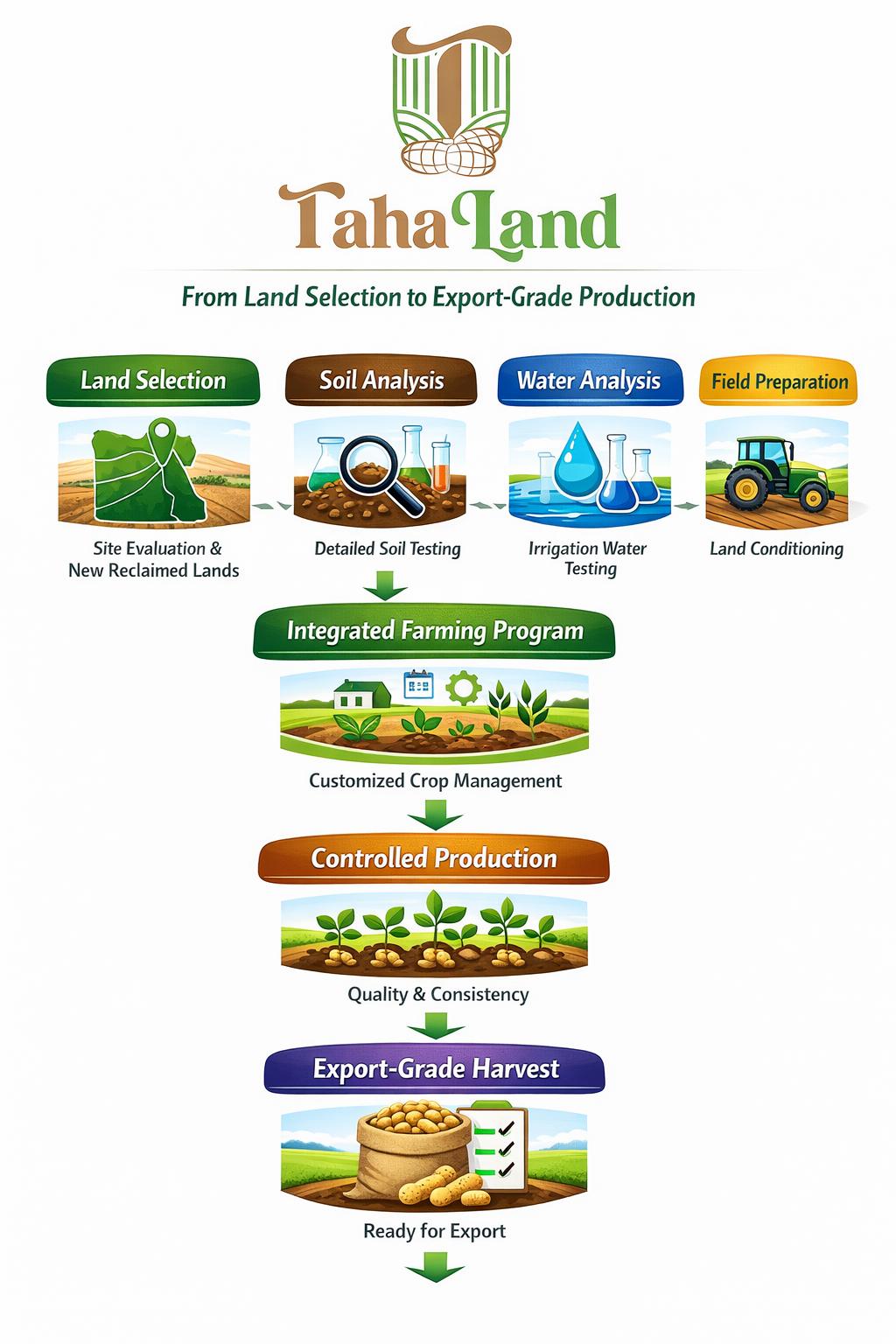
Land Selection in Egypt
Egypt offers outstanding agricultural potential — especially in newly reclaimed lands, where modern infrastructure and controlled conditions allow precision farming from day one.
Our land selection is a structured process, focused on long-term productivity and export suitability. We evaluate each plot based on:
• Soil structure and suitability for peanuts
• Drainage and field uniformity
• Irrigation availability and system efficiency
• Sustainability potential across multiple seasons
We don’t simply “plant peanuts.” We build a stable foundation for reliable export supply.
⸻
Soil Analysis Comes First
Before any cultivation decision is made, we begin with professional soil testing to understand the field’s true capability.
Our soil assessment typically covers:
• Texture, structure, and drainage profile
• pH and salinity levels
• Organic matter content
• Macro and micro nutrient balance
• Field variability mapping (when required)
These results guide every decision that follows — from variety selection to fertilization and irrigation strategy.
⸻
Water Source Evaluation & Laboratory Testing
Water quality is a core driver of yield stability and kernel quality.
Every irrigation source is evaluated and tested to confirm its long-term suitability, including:
• Salinity and mineral composition
• Irrigation compatibility
• Impact on soil structure and nutrient availability
• Seasonal stability and operational reliability
Only water sources that support consistent, export-grade results are approved for production.
⸻
A Complete Agricultural Program — Designed for Performance
Based on soil and water data, Taha Land develops a complete seasonal program for each farm. This includes:
• Variety selection aligned with market preferences
• Planting schedule optimized for climate and field readiness
• Fertilization plan tailored to soil requirements and crop stage
• Irrigation plan for controlled growth and uniformity
• Preventive plant protection to reduce risk before it appears
• Continuous monitoring and seasonal adjustments for consistent outcomes
The goal is not only yield — it is uniform quality, stable performance, and predictable export readiness.
⸻
Farming for Export — Not for Volume
Our farms are managed with a clear objective: export compliance and consistency.
This means our production decisions are aligned with:
• Size and grading expectations for international buyers
• Quality stability across shipments
• Hygienic handling and controlled post-harvest practices
• A supply approach built for long-term partnerships, not one-off deals
⸻
Sustainability & Long-Term Reliability
We believe that sustainability is not a slogan — it is a production strategy.
Our farming model supports:
• Efficient use of water resources
• Soil preservation and long-term fertility
• Responsible input management
• Seasonal consistency and controlled risk
Sustainability, for us, means one thing: reliable supply today and stronger farms tomorrow.
⸻
Connected to Traceability
Everything we do in the field is designed to connect seamlessly to our Traceability System.
Each farm cycle is recorded, and each production lot is linked to:
• Batch/Lot identification
• Quality checkpoints and testing records
• Packaging and shipment documentation
• QR-based access for verification
This creates transparency across the entire chain — from farm to final destination.
⸻
Our Principle
Strong exports start with strong land.
Science, discipline, and traceability turn farms into reliable supply chains.